


How is the color of a swimming pool perceived? Factors to keep in mind
When planning to build a swimming pool, one of the greatest technical and architectural challenges is predicting the exact color the water will be. People often make the mistake of thinking that the final color depends solely on the shade of the tiles chosen. However, the final look is a direct result of the physics of light and optics.
If you’re looking for inspiration on color palettes, we recommend checking out our guide to choosing water color or taking a look at some trendy colors. But if you'd like to understand why water becomes a specific shade and how materials interact with their surroundings, this article analyzes the technical factors that come into play.
The science behind water: why does it look blue if it's actually transparent?
To understand how color works in a swimming pool, one particular myth must first be dispelled: water does not merely mirror the sky. Water has an intrinsic color.
When white sunlight penetrates the water in a swimming pool, a physical phenomenon known as selective absorption occurs. Water molecules act as a filter that rapidly absorbs the longer wavelengths of light—the red, orange and yellow colors. Conversely, the shorter wavelengths—such as blues and greens—are not absorbed, but instead bounce off, scatter and reach our eyes. It is for this scientific reason that, above a certain volume, the eyes perceive clear water as having a distinct bluish tinge.
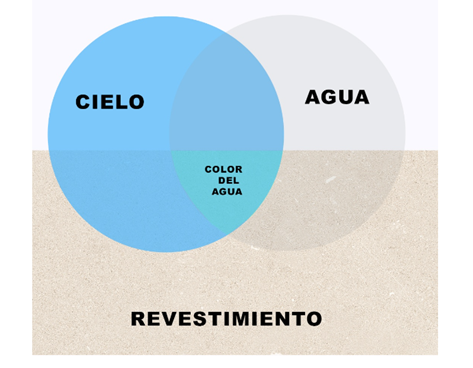
The optical triad in the color of swimming pool water: sky + water + lining
The The final perception of color in a swimming pool does not depend on any one element, but rather on an indivisible optical equation involving three factors:
- The sky: a source of reflected light. It acts as both a light source and the main reflective surface. A clear sky will provide intense white light and a vibrant blue reflection, whilst a cloudy sky will filter the light, reducing the color intensity.
- Water as an optical filter. As already mentioned, it acts as a natural blue filter that alters any color beneath it.
- The ceramic tiling as a background canvas. It's the surface from which the light that has managed to pass through the water is reflected.
The color perceived by the human eye is the result of light passing through the water, striking the ceramic, mixing with the color and passing back through the water towards the surface.
The behavior of light: absorption, reflection and refraction
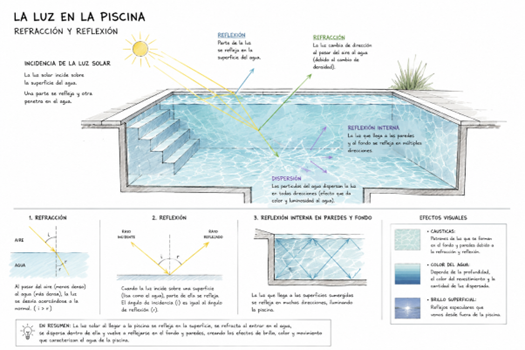
To master swimming pool design, it's essential to understand how light behaves when striking a pool.:
- Absorption: this depends on the color of the porcelain stoneware. Dark tiles absorb most of the light, creating an infinite depth effect Light-colored tiles have a high reflectance, reflecting almost all the light back towards the surface and making the water sparkle. Reflection
- Reflection:: this is the mirror effect. Some of the sunlight does not penetrate the water but rather bounces off the surface. Depending on the angle of the sun and the wind, the pool will reflect the sky or the surrounding architecture, altering the perception of color within the pool. Refraction
- Refraction:: this occurs when light passes from a less dense medium, such as air, to a denser one, such as water. The light bends and changes speed, creating optical illusions that make the bottom appear closer than it actually is, or give the textures of the ceramic tiles a subtle visual movement.
How does depth affect the perception of the water color?
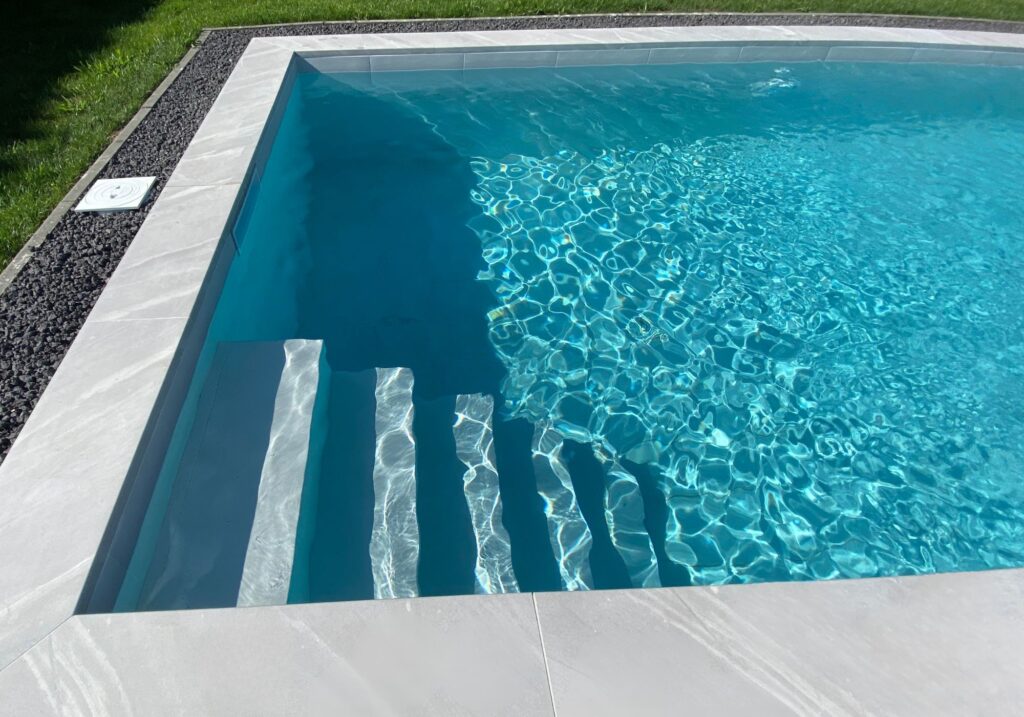
The amount of water; in other words, the depth of the pool, is a critical variable. In accordance with the principle of selective absorption, the greater the depth, the greater the thickness of the water filter that the light must pass through.
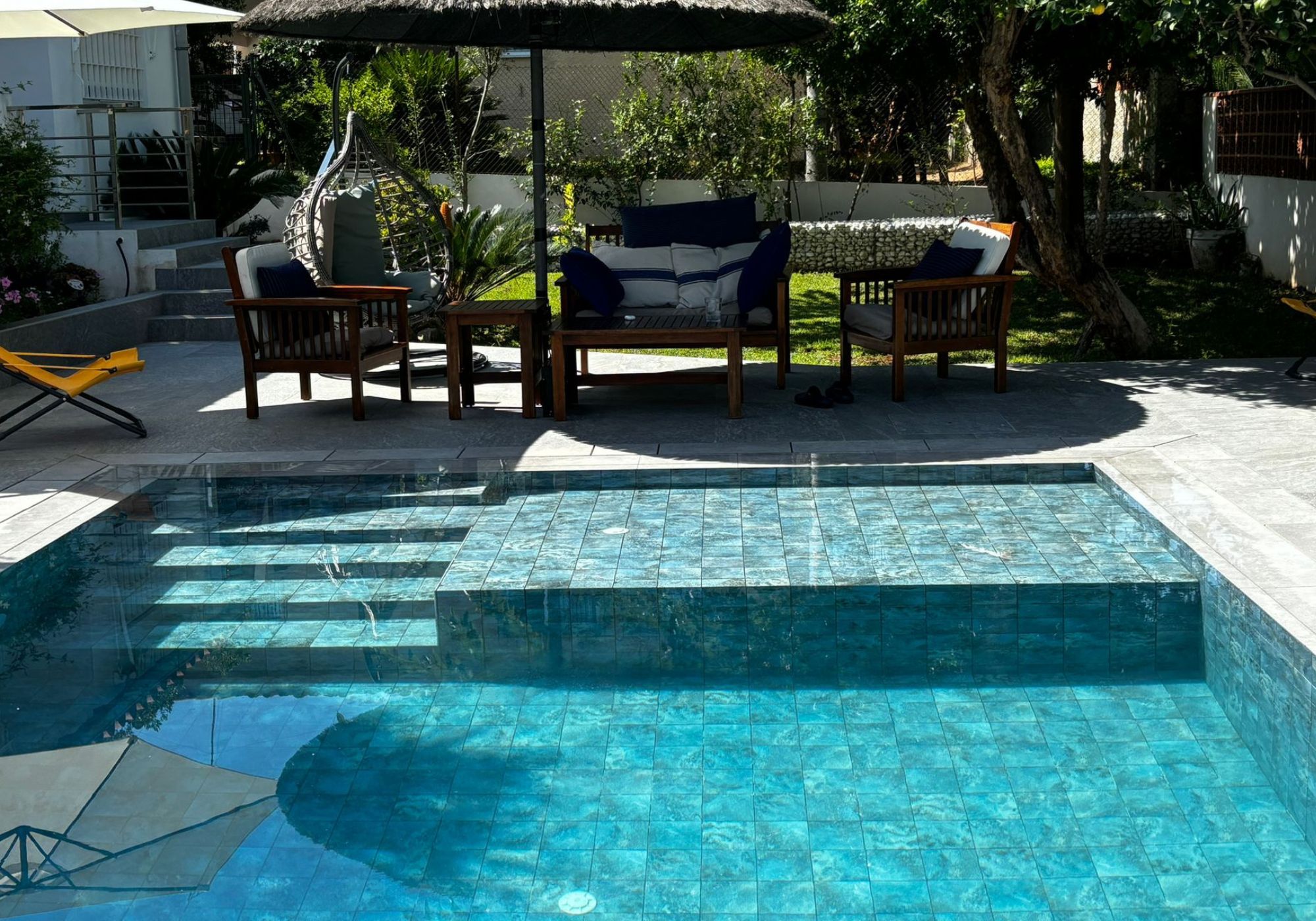
- In In shallow areas such as , como las access beaches or stair treads, the light passes through a very thin layer of water. In these areas, the ceramic tiles can be seen very clearly as the water barely alters their original color.
- As the depth increases, the light must travel through a greater thickness of water. During this time, the water progressively absorbs the warmer wavelengths (reds, oranges and yellows) and scatters some of the light, causing blue and green tones to predominate. As a result, the color of the tiles appears more intense, deeper and slightly different from what is seen when dry.
This phenomenon explains why a swimming pool never has an even color. The result is a natural color gradient that varies with depth, the color of the tiles, the angle of the sunlight and the state of the sky, adding visual richness and a sense of greater depth.
The optical effect depending on the color of the pool tiling
Understanding the physics described above makes it possible to explain why each type of tile produces a different water color: White background::
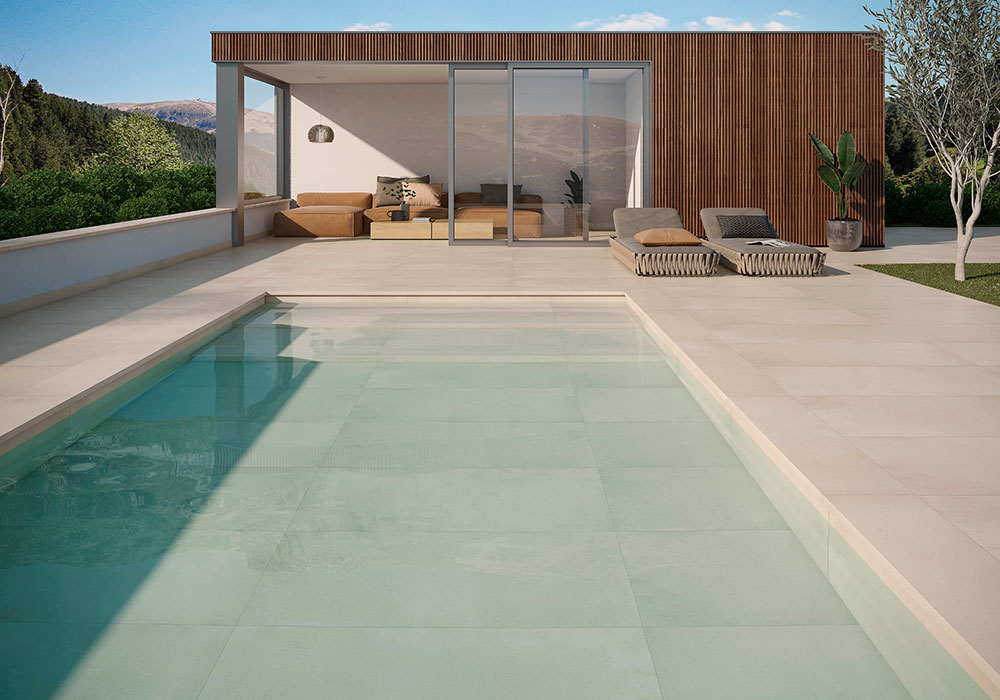
- White bottom: since the tiles reflect all the light, white tiles reflect the blue hue of the water in its purest form. The result is a crystal-clear, luminous sky blue. Beige or sand background:
- Beige or sand-colored bottom: sand-colored porcelain stoneware reflects warm tones. When the yellow of the background combines with the intrinsic blue of the water, the human eye physically perceives a turquoise green, reminiscent of the water in the Caribbean Sea.
- Gray or black background: these shades absorb a large part of the light spectrum. As very little light is reflected, the blue of the water becomes more intense, creating perfect reflections of the surrounding architecture and giving the appearance of a deep, natural lake.
The color stability of porcelain tiles: a color that never fades
There is one technical factor that is decisive in the long term: the stability of the substrate. Given that the color of the water depends on the light reflected off the tiling, the color of the water will inevitably change if the substrate material fades over time.
This is where one of the greatest technical advantages of using ceramic tiles lies. Unlike paints or other materials that degrade due to UV rays, chlorine or salt, Gres Aragón’s porcelain stoneware offers absolute color stability. The vitrification of the ceramic at extremely high temperatures makes the material inert. The color, refractive index and properties remain unchanged from day one, ensuring that the design and optical performance of the swimming pool will last indefinitely.
Design the swimming pool of your dreams with Gres Aragón’s technical guarantee
Elegir el revestimiento cerámico Choosing the right ceramic tiling is not just a matter of esthetics; it's a technical decision that will define the light behavior of your project. At Gres Aragón, we offer you our porcelain and porcelain tile collections extruded high-performance tile collections so that design, slip-resistance and color stability go hand in hand.
Are you planning your next swimming pool project or do you need technical advice on which collection best suits your vision?
👉 Download our specialist swimming pool catalog and and get in touch with our team of ceramic tile experts. They will answer your questions and help you bring your project to life without any visual or technical surprises.